
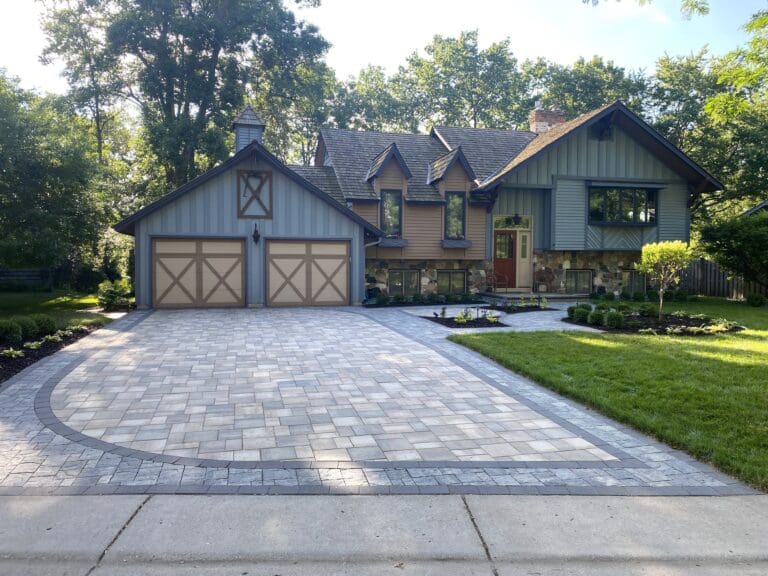
Why Plymouth Homeowners Are Switching from Poured Concrete to Driveway Pavers
In Plymouth, Minnesota, outdoor home improvement projects require careful planning for our distinct weather conditions. Between brutal winter freezes, rapid spring thaws, and summer heat, suburban driveways endure significant climate strain. For decades, poured concrete was the default choice for homeowners across Plymouth neighborhoods like Wayzata Highlands, Elm Creek, and West Medicine Lake. However, a major shift is occurring: homeowners are increasingly replacing cracking, spalling concrete slabs with high-performance interlocking driveway pavers.
At Yellow Brick Road Pavers & Landscape, we have spent over 35 years helping Twin Cities homeowners design and build durable, high-value outdoor living spaces. If you are weighing your driveway material options, here is why interlocking concrete pavers consistently outperform poured concrete in Plymouth.
1. The Minnesota Freeze-Thaw Problem
The primary issue with poured concrete in Minnesota is its rigidity. When moisture penetrates the soil beneath a driveway and freezes, the ground expands and shifts—a process known as frost heave. Because a poured concrete slab is one monolithic unit, it cannot flex with this movement. Over time, stress builds until the slab cracks. Even reinforced concrete with control joints eventually succumbs to expanding ice, de-icing salts, and surface spalling.
Interlocking driveway pavers solve this challenge through structural flexibility. Installed over a deeply compacted aggregate base, pavers function as an interlocking network of individual units. During winter freeze-thaw cycles, the joints flex naturally with subtle ground movements and settle back into place during the thaw—without structural cracking.
2. Seamless Repairability vs. Costly Concrete Replacement
When poured concrete cracks, flakes, or stains from oil and vehicle fluids, repairing it seamlessly is nearly impossible. Patching materials rarely match the original concrete color, leaving visible blemishes. Ultimately, repairing significant concrete damage requires tearing out and repouring large sections of the driveway.
Driveway pavers offer unmatched repairability. If a section is ever damaged or stained, individual pavers can be removed, replaced, or reset without disturbing the surrounding driveway. Furthermore, if utility work ever requires digging under your driveway, pavers can be lifted and reinstalled to look good as new—something impossible with poured concrete.
3. Superior Strength and Weight Distribution
Standard residential poured concrete typically features a compressive strength of around 3,000 to 4,000 PSI (pounds per square inch). Interlocking concrete pavers, manufactured under extreme pressure, regularly exceed 8,000 PSI. This higher density makes pavers far more resistant to vehicle loads, heavy snowplows, and freeze-thaw absorption than traditional poured slabs.
4. Instant Curb Appeal and Higher Resale Value
A driveway makes up a significant portion of your home’s front exterior. While plain gray poured concrete can look industrial or dated, interlocking pavers immediately upgrade your property’s curb appeal. With a vast selection of colors, textures, and patterns—from modern large-format slabs to classic cobble textures—paver driveways can be customized to complement Plymouth’s diverse architectural styles. Local real estate trends show that high-end hardscaping delivers strong return on investment by creating lasting visual impact.
Poured Concrete vs. Driveway Pavers: Quick Comparison
| Feature | Poured Concrete | Interlocking Driveway Pavers |
|---|---|---|
| Freeze-Thaw Performance | Rigid; prone to cracking and spalling | Flexes with ground movement without cracking |
| Compressive Strength | ~3,000 – 4,000 PSI | 8,000+ PSI |
| Repairability | Patches show easily; often requires full replacement | Individual pavers can be lifted and reset seamlessly |
| Design Customization | Limited to gray slab or stamped patterns | Endless patterns, colors, borders, and textures |
| Long-Term Value | Lower upfront cost; higher long-term maintenance | Higher initial investment; 30+ year lifespan with minimal upkeep |
Why Professional Base Preparation Matters in Plymouth
Whether installing pavers or poured concrete, hardscaping longevity depends on base preparation. In Plymouth’s clay-heavy soils, proper excavation, geotextile fabric installation, base compaction, and drainage management are essential to prevent settling. At Yellow Brick Road Pavers & Landscape, our in-house installation teams build every driveway foundation to exceed local climate demands—ensuring your investment looks magnificent and stays level for decades.
Frequently Asked Questions
Do driveway pavers hold up to Minnesota snowplows and shovels?
Yes. Professionally installed pavers feature tight joints and smooth chamfered edges that allow snowplow blades and shovels to glide over them without catching. Polymer jointing sand locks the pavers together to create a smooth, solid surface.
How do paver driveways handle de-icing salt in winter?
High-density concrete pavers are much more resistant to de-icing chemical scaling than poured concrete. For optimal longevity, rubber-based de-icers or traditional coarse sand are recommended for traction during Plymouth winters.
Do weeds grow up between driveway pavers?
No. When installed with modern polymeric sand, the joints harden to form an impenetrable barrier that prevents weed growth and deters insects while maintaining joint flexibility.
How long does a paver driveway last compared to concrete in Plymouth?
While poured concrete driveways often develop noticeable cracking within 10 to 15 years in Minnesota, a professionally installed paver driveway can easily last 30 to 50 years with minimal maintenance.
